


Free
$0 / mo
Free forever, no card.
- Unlimited capture on your devices
- 3 meeting whispers / month
- A few premium, deep-analysis meetings each month
- 200 chat turns / month
- 30-day memory window
- 1 connector, 1 GB knowledge
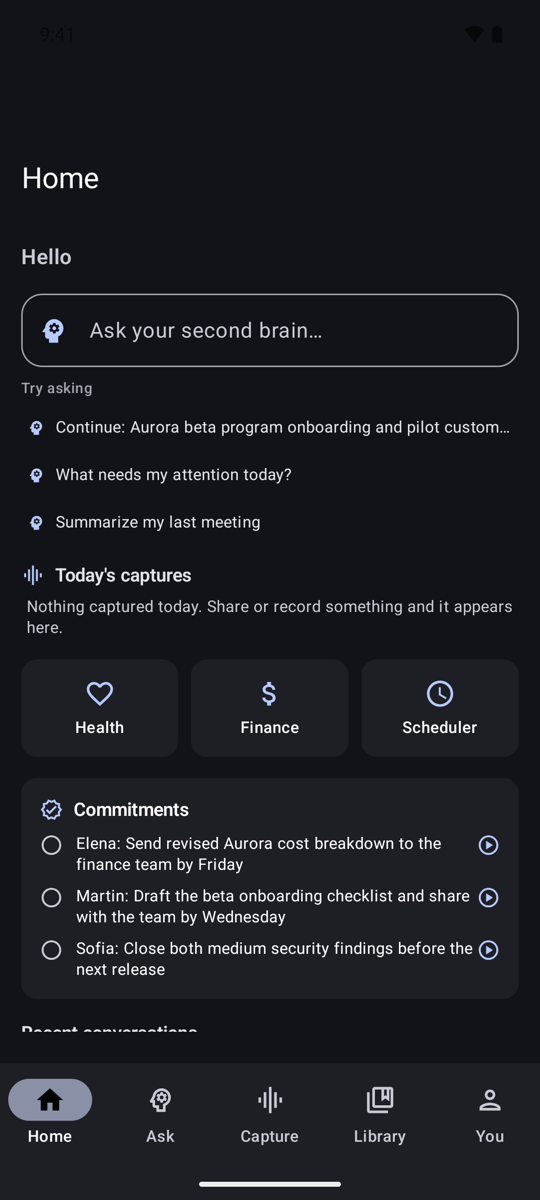
Paredra sits beside you in every meeting. It catches commitments and contradictions while people are still talking, then remembers everything into a private knowledge graph you can ask.
Capture
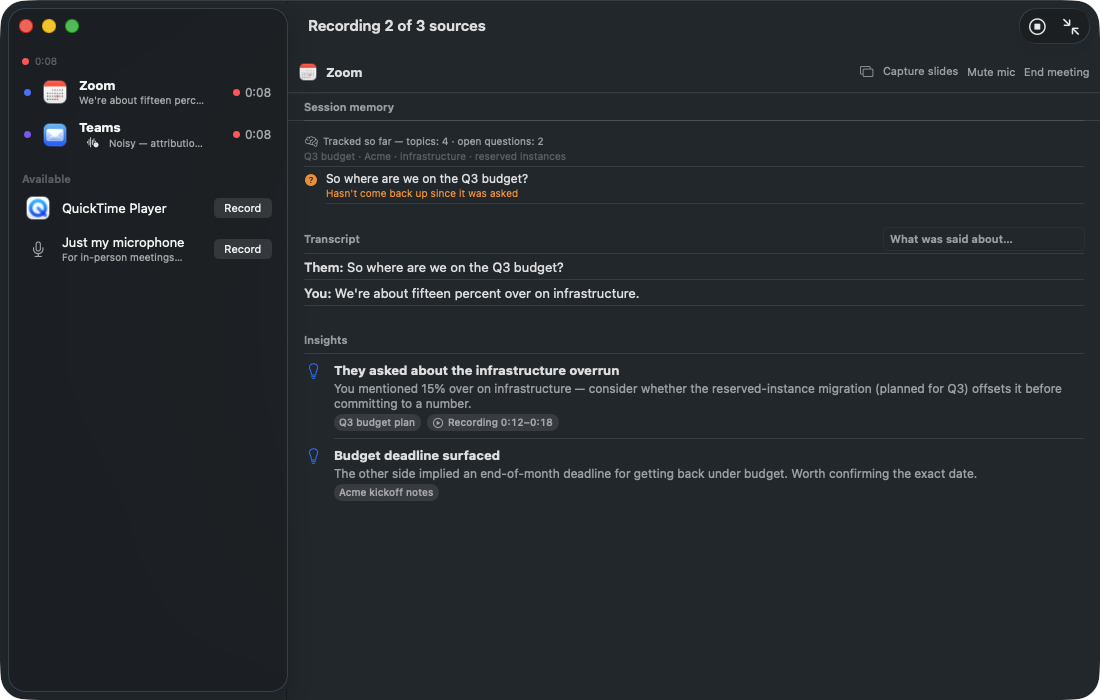
Nothing joins your calls or announces itself to the room. On your Mac, Paredra records each meeting app directly, even two overlapping calls, and files each one to the right client.
Meeting audio is captured from the app itself and transcribed on your machine. The audio never leaves it: only the text of the meeting reaches your memory. A structured note with the summary, actions, and decisions arrives the moment the call ends.
per app Zoom and Teams taped separately, at the same time
on device transcription runs on your Mac, audio stays
attributed your mic lane knows which words are yours
Bluewick weekly
10:00
Farhaven standup
10:00
two lanes, taped apart
transcribed on device
audio never leaves
summary · 3 actions
filed to Bluewick
summary · 1 decision
filed to Farhaven
Only the Mac records two apps at once, and nobody else does it without a bot. iPhone and Android record the room, one meeting at a time. Windows syncs your vault, notes, and chat; the web app answers from anywhere.
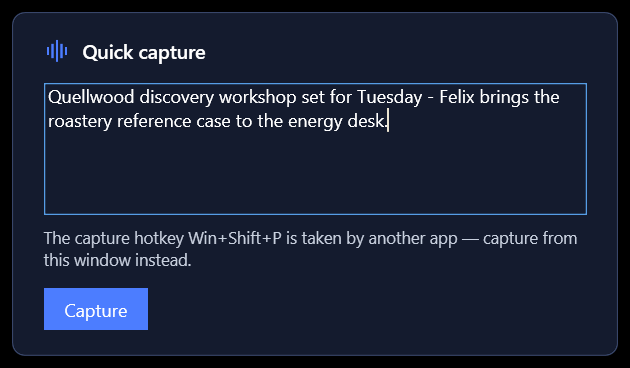
Meetings are half of it. A hotkey on Windows, a quick note on your phone, a photo, a file dropped in a watched folder: whatever crosses your mind lands in the same memory as your meetings, filed and searchable.
one hotkey Windows quick capture, typed and saved in seconds
anywhere quick notes and photos from iPhone and Android
watched folders drop a file, it joins your knowledge
Memory
Every meeting, file, message, and note becomes a node, linked the way things actually relate: people to projects, decisions to the meetings that made them, commitments to the people who gave them.
The graph is why an answer can cross sources. The meeting knows its client, the client knows its project, the project knows who promised what. Ask about any of them and Paredra walks the links instead of searching one app at a time.
linked decisions point at the meetings that made them
lit commitments stay amber until they are kept
whole seven clusters here: six clients and a life
Six weeks of one consultant's meetings, drawn as one map. Sample data.
A pile of notes is not memory. Paredra organizes everything it captures into five connected layers, so it can tell what it observed, what exists, what happened, what you are aiming for, and what should happen next.
Every mention, claim, and commitment heard in a meeting or found in a document lands here first as an observation, and each one carries a tag naming its source. Nothing enters your memory without a receipt: that is what the tags under each dot are.
People, companies, projects, accounts. Three observations that mention the same person converge into one clean record of her, linked to the project and company she belongs to, instead of a duplicate for every document.
Meetings, decisions, and milestones take their place on a timeline, tied to the people and projects they involve. Each event stays anchored to its recorded moment: the seconds of audio, the slide, the page where it happened.
A commitment made in that meeting is lifted out and flagged, pointing at its due date. Goals, promises, preferences, and constraints live here: the part of your world most tools hear once and throw away.
The commitment becomes tasks and follow-ups, each connected upward to the intention it serves. When one is done, the layers above already know why it mattered and where it came from.
Every layer keeps its provenance: where a fact came from, how confident Paredra is, and how often it has been confirmed. Ask why, and it shows you the source.
Recall
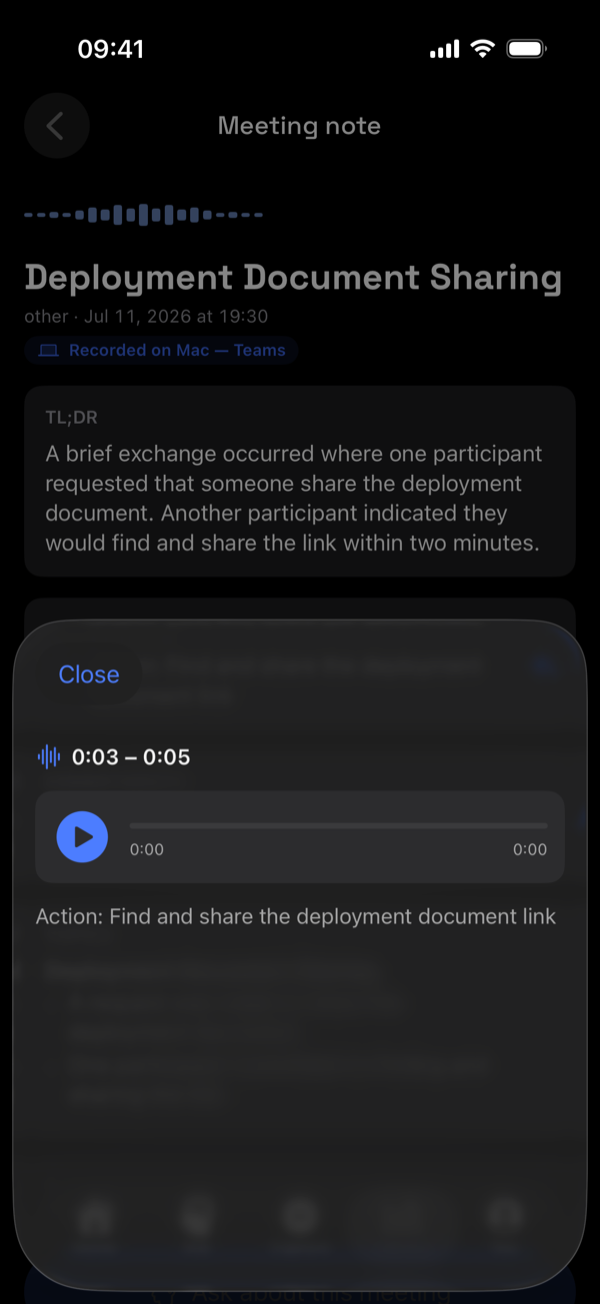
Ask anything about your work and life. The answer is grounded in your graph and cites its evidence: the document page, the email, and the exact thirty seconds of the meeting where it was said, playable in place.
moments answers link to the second in the recording
sources every claim opens the page it came from
any language ask in Spanish, find the English doc
Act
Paredra does not stop at remembering what happened. It lifts out the commitments people make, holds them to their due dates, and speaks up when the story changes.
Every promise made in any meeting becomes a tracked entry: who said it, their exact words, the due date, and the moment in the recording where it was said. When a due date passes unmet, the ledger says so.
When a new claim conflicts with something already in your memory, from any source, Paredra shows you both sides with their receipts: the claim from today's meeting next to the note from June that says otherwise.
Yours
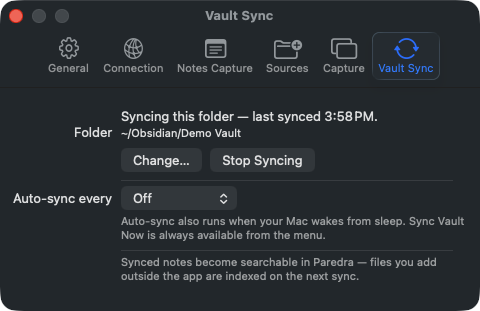
Meeting notes land in your own Obsidian vault as plain Markdown. Write in the vault and it syncs back, searchable. Leave any time; the files are already yours, readable by anything.
plain Markdown notes in a folder you choose
two-way write in your vault, it syncs back
your rights export everything, or delete everything
Paredra is built by life2.ai, a boutique AI engineering firm that treats software like infrastructure: built once, run for years. The privacy posture is not a setting. It is the drawing the product was built from.
Read the security posturePlatforms
Record on your Mac, capture on your phone, sync your vault on Windows, ask from any browser. One account signs in everywhere; your graph follows you.
Or download directly for Mac or Windows.
Two-at-once capture and on-device transcription are Mac abilities. Phones record one meeting at a time. Windows keeps your vault, notes, search, and chat in sync; the web app asks and answers from any browser. How each one works.
Every new account gets 14 days of full Pro, no card. When it ends, Free keeps working forever.
$0 / mo
Free forever, no card.
$29 / mo per user
Everything, without limits.
$49 / seat / mo
A shared brain for small teams.
Everything in Pro plus group memory, group chat, and an admin console. Not open yet. We will announce it here first.
Plan details, the annual toggle, and the full comparison live on the pricing page.
The mark is the second chair: two seat backs on one ground line, seen from behind, facing the same room, the amber one beside yours. Six versions of that one concept, varied on proportion, weight, negative space, and motion. Flat geometry, horizontal lockups, no serif. This page wears the first; the verdict stays a founder decision.
The original: your chair carries the weight, the amber one sits close enough to touch shoulders. Worn by this page.
Both chairs the same size. Reads as a peer at the table, not an assistant behind you.
The same pair cut heavy, with a thick ground. Built to survive a favicon, a tray icon, and a phone home screen.
A single slab split by a seam of night: two seats cut from one piece of furniture. The pair becomes one object.
The amber chair caught mid-slide, arriving beside yours. In product it slides in once; the still frame keeps the motion ticks.
The two backs touching, the amber one a notch lower. As close as the concept can be drawn without merging the chairs.
The graph, brain, and P family and the earlier second-chair strategies are retired. Companion life2.ai marks live with the life2 site; life2 was not touched this round.
Stories from people who gave their work and life a real memory.
A double-booked consultant, one Mac, and the afternoon both meetings became notes.
EvidenceScope creep ends where the record begins: exact words, dates, and playable moments.
MemorySixty years of family history, recorded over coffee and preserved as a world you can ask.
Paredra is Ancient Greek for “one who sits beside.” In Plato’s Laws it means an assessor, a second-chair counsel. The product is named for that role: an AI that sits beside you, grounded in your own data, instead of a generic assistant trained on the public internet. More on the about page.
There is no bot: nothing joins the call or announces itself. Paredra captures the meeting audio directly from the meeting app on your Mac and transcribes it on your machine; the audio never leaves it. While the meeting runs, it whispers suggestions only you can see: commitments as they are made, questions left open, claims that conflict with your own notes. Every suggestion cites a source it verified first.
It is a live map of your work and life. People, projects, files, decisions, and the meetings that touch them, linked the way they actually relate. The graph is what lets Paredra answer questions across sources rather than searching one place at a time, and it is what makes the Whisperer feel like it already knows the room.
Start with what is already on your machine: any local folder, including your Dropbox, OneDrive, and Drive sync folders, plus Apple Photos. None of that needs an account connection. Your meeting notes also sync outward into your Obsidian vault as plain Markdown: files you own, readable by anything. For cloud-side sync, connect Google Calendar or pick exactly which files Paredra sees with the Google Drive picker. Cloud connectors for OneDrive, Dropbox, and Box are coming soon, and every connector can be turned off at any time.
General chatbots do not know your work or your life. They only remember within a single conversation. Workspace AIs know one app: the documents inside their own walls. Paredra is the layer above. It listens to the meetings, reads across the tools you already use, and weaves it all into one knowledge graph. Every answer comes back grounded in your sources, with citations you can open.
Yes. Both are your rights: a machine-readable export of your data and chat history, and full account deletion. You can delete your account directly in the iOS app. For a data export, or to delete your account without the iOS app, write to privacy@paredra.ai and we will complete your request within the legally required timeframe.
Connect a calendar, drop a few documents, and have a second chair in your next meeting.
Try Paredra free